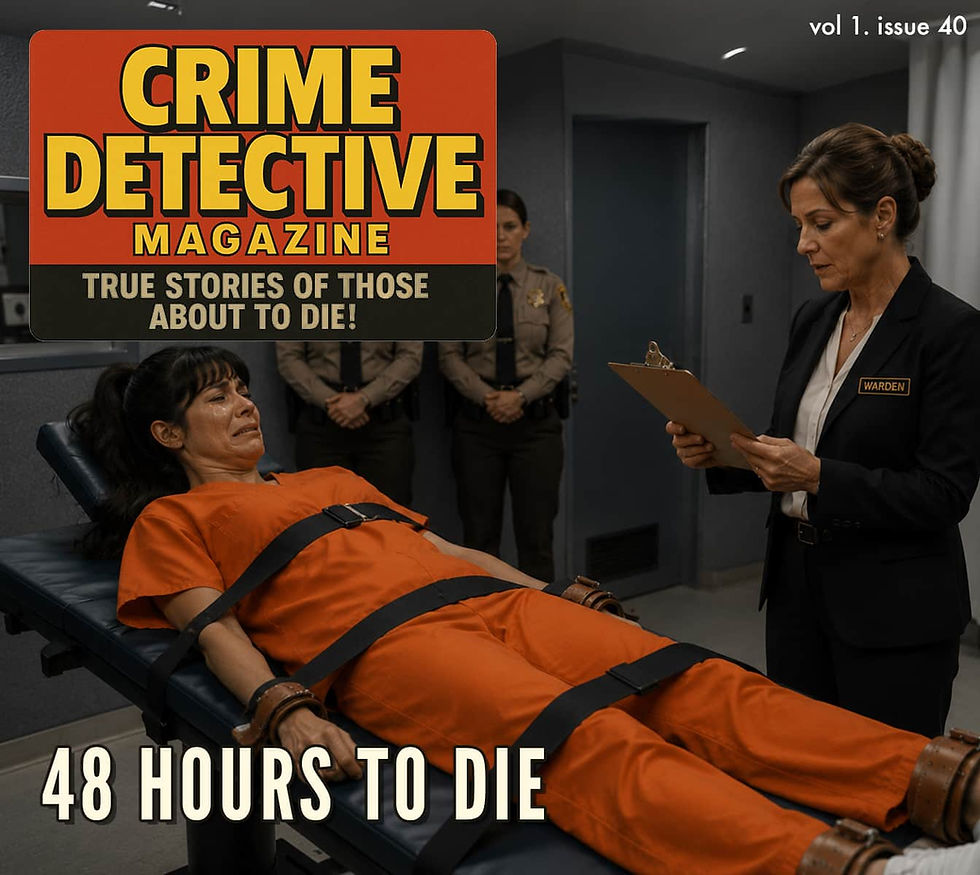
The Last Letter of Theresa Blanchard
- Jul 25, 2025
- 5 min read
Chapter One: Cheap Rooms and Cheaper Promises
Theresa Blanchard met Edward Jones on a Thursday, under the flickering neon buzz of a Gulf station outside Shreveport. She was twenty-eight, slinging hash and watching her life go nowhere in a hurry. He had a leather jacket two sizes too small and eyes like a storm that never cleared.
Said he had plans. Said they could live like ghosts, drifting from state to state with pockets full of other people’s money. She said yes before he finished the sentence.
The robbery was supposed to be simple. In and out of a roadside motel off Route 61.
Manager was old, hard of hearing. Edward had the gun. Theresa was lookout. Just scare him, get the cash, disappear into the dark. But things went wrong the minute the door opened. The manager pulled a bat. There was yelling. A shot fired—loud, final.
The old man hit the ground and didn’t get up.
Chapter Two: Fall Girl
They didn’t get far. Less than two miles before the state troopers boxed them in like scared cattle. At the station, Edward cracked. Claimed he never touched the gun. Said Theresa went off-script. Said she was unhinged.
She didn’t argue. Not once. Some said she was in shock. Others figured she was protecting him. The press loved it—“The Motel Siren and Her Judas Lover.” Headlines ran coast to coast.
In court, Edward wore a new suit and cried on the stand. Told the jury he was terrified. That he begged her not to shoot. The D.A. pointed to the gunpowder on Theresa’s hands. To the trajectory. The distance. The jury was out for three hours. Came back with Guilty.
First degree. Premeditated.
The judge read the sentence like he was bored: "Death by lethal injection. To be carried out at a time and place chosen by the state."
Chapter Three: Time Like Tar
Death row in Linwood Women’s Facility was a place where hope dried up like a puddle in a furnace. Theresa had cell B3. It faced a wall and smelled like bleach and mildew. She didn’t talk much, but she wrote every day. Letters to Edward. Legal notes. Fragments of poems.
Dear Eddie,You looked nice in that tie. I almost didn’t recognize you with your hair slicked back. If you ever think of me, think of that time we danced in that laundromat in Amarillo. The one with the jukebox. The one where we laughed until the sun came up.-T.
Her lawyer, Margaret Cline, came monthly. A pit bull in pumps. Filed motions. Appealed to the circuit. Filed again.
“There’s doubt,” she’d say. “We just need time.”
But time doesn’t like women like Theresa. It chews them slow and spits them into the dark.
Seven years passed. Seven Christmases. Seven hot summers with no breeze. Seven failed appeals. Then the date came. A Thursday. Just like the one she met him on.
Chapter Four: The Last Shower
The morning of her execution was silent, save for the buzz of the lights and the shuffle of guards. They brought her breakfast. She didn’t touch it. At 9:00 a.m., the nurse came with the bundle. Shower, she said. Time to clean up.
Theresa undressed slowly, like each movement was a goodbye. The water was hot. The soap was cheap. She scrubbed every inch of herself, like she was washing away someone else's fingerprints. Afterward, they gave her the diaper. No ceremony, no shame. Then came the white medical gown, stiff and starched. Disposable dignity. Two guards escorted her down the corridor. One was new. Couldn’t make eye contact.
They walked past empty cells, past women who looked away, past decades of steel and ghosts. Margaret was waiting by the door to the chamber. Eyes red. Hands clenched.
“You did your best,” Theresa said. “I didn’t do enough.”
Chapter Five: Needle in the Dark
The chamber smelled like antiseptic and cold steel. It was the kind of room that didn’t just kill you—it erased you.
Theresa stepped through the door with no resistance. Her feet were bare. The white gown hung loose on her frame, like it already expected a body without breath. The fluorescent lights above her hummed like they were the last sound she'd ever hear. The gurney in the center of the room was padded, but it might as well have been concrete.
Wide leather straps sat open—one for each wrist, each ankle, across the thighs, across the chest. Two nurses waited beside it—one older, one too young to be doing this.
“Miss Blanchard,” the younger said softly. “Please lie back.” She didn’t speak. Just nodded and climbed on, slow and steady, like a woman settling into her final bed.
The older nurse took her right arm, searching for a vein with practiced fingers. She slapped the inside of her forearm a few times, then slid the needle in like she was threading a wire through glass. The second nurse did the same on her left. Two IVs. Redundant, in case one failed.
Above her, a large clock ticked quietly. 11:57 a.m.
The chaplain stood near the corner, murmuring something about grace. Theresa didn’t hear it. She kept her eyes on the ceiling tiles—counted them, like prayers she no longer believed in. Through the glass, witnesses stared. Two reporters. Margaret. A prison chaplain. And someone with a beard who could’ve been Edward—but wasn’t. Just another stranger watching her end like a television show. The warden stepped forward, voice flat, clipped.
“Miss Blanchard, do you have any final statement?”
She turned her head toward the glass.
“I hope he sleeps easy. I hope it was worth it.”
She turned back to the ceiling.
“I forgive him,” she whispered. “That’s all.”
The warden nodded. At 12:01 p.m., he gave the signal.
The first syringe—sodium thiopental—flowed down the line. A heavy sedative meant to put her under. She felt it immediately. Cold in the veins, like ice water spreading through her bloodstream. Her chest got heavy. Her vision blurred at the edges. It was like sinking into deep water with no bottom.
Then came the second drug—pancuronium bromide. A paralytic. Her muscles seized then froze. She couldn’t move, couldn’t blink, couldn’t even shiver. Her lungs stopped trying. The only thing left working was her heart, galloping like a frightened horse.
The final drug came last—potassium chloride. It burned. Even through the sedation, she felt it. A rush of fire in her arms, her neck, her chest. Her heart squeezed once—hard—then stopped cold.
The monitor flatlined at 12:07 p.m. Theresa Blanchard was dead. No cries. No gasps. Just a silent exit into the void.
The doctor checked her pulse, shined a light into pupils that no longer cared.
“Time of death: twelve-oh-seven p.m.” The straps were loosened. Her hands dropped limp at her sides. A thin trickle of blood from the IV site ran down her arm and dried against the white fabric. Outside the glass, no one moved.
Epilogue: The Letters
Theresa’s personal effects fit in a shoebox. Inside were paperback books, a cross on a chain, and a stack of unsent letters—all addressed to Edward Jones.
The last one said:
They say this chair is mercy. But the worst part is knowing you’re out there somewhere, living like it never happened. I don’t hate you. I just wish you'd said goodbye.Still yours,T.
They cremated her the next day. No one claimed the ashes. In a landfill outside of Monroe, the letters turned to dust. And somewhere, under a different name, Edward Jones lit a cigarette, stared out at the morning sun, and felt—nothing.
Not guilt. Not grief. Just the heat on his face, and the weight of a name no longer his.