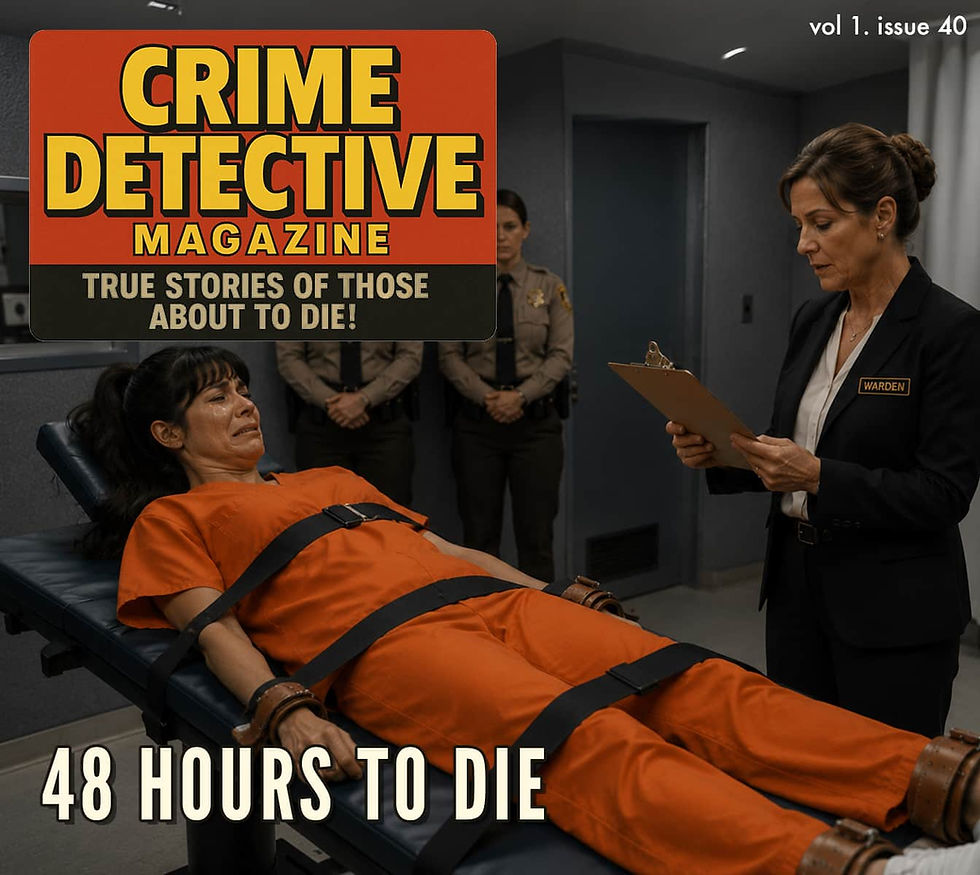
Three Jolts to Justice: The Execution of Natasha Warner
- Aug 11, 2025
- 6 min read
Natasha Warner’s story began in the peeling aluminum walls of a trailer on the edge of a dying West Virginia town. Born in 1955, she grew up surrounded by empty beer bottles and the sour smell of cigarettes. Her parents were both drunks, trading bar fights for food money, and she learned early that if she wanted something, she’d have to take it.
By 16, she was skipping school and riding in stolen cars. By 20, she was running liquor store stick-ups with a sawed-off shotgun. Her criminal résumé grew with each desperate year—gas stations, pawn shops, the occasional grocery store—until she met Larry “Two-Shot” Williams, a lanky, wild-eyed ex-con with a drawl as slow as molasses and a temper that could cut glass.
Together, they carved a trail of holdups that stretched from the hollers of West Virginia all the way into Texas. The newspapers called it a “cross-state crime spree,” but to Natasha, it was survival with a little adrenaline kick.
That survival ended in a screech of tires and gunfire outside of Waco.
The Last Job
It was a Chevron station just after midnight. The clerk was too slow on the till, Larry waved his .38 like he was swatting flies, and Natasha grabbed the bills and cigarettes. But someone had already hit the silent alarm. Within minutes, the state troopers were on them.
What followed was thirty miles of flashing lights, busted guardrails, and the smell of burning rubber. When the road ahead lit up with a blockade of patrol cars, Natasha didn’t see surrender—she saw a trap. She leaned out the passenger window and opened fire. Two officers fell before the car was spun out into a ditch.
When the dust cleared, Larry had his hands up. Natasha didn’t. It took four troopers to drag her down.
Trial and Sentence
Texas justice moved fast in the ’80s. Natasha’s trial lasted just two weeks. The prosecution painted her as a cold-blooded killer who had “chosen bullets over mercy.” The defense tried to spin a tale of a broken girl in a broken system, but the jury wasn’t buying it. They came back after one hour—guilty of capital murder, death penalty recommended.
Natasha was 32 years old.
Seven Years on the Row
The Mountain Laurel Women’s Unit in Huntsville became her world. She spent 23 hours a day in a six-by-nine-foot cell with a cot, a stainless steel sink, and a slot for food trays. The years were a blur of court motions, denied appeals, and the slow understanding that Texas was going to kill her.
Somewhere in that stretch of years, Natasha found God. She learned to read scripture with a quiet intensity. She taught illiterate inmates their ABCs and gave hard lessons about the cost of bad choices. The guards started calling her “Teacher,” but no amount of redemption was going to erase the blood in her past.
By September of 1987, the last appeal was denied. Her execution date was set for October 21st.
The Last Days
Three days before her execution, she was moved to the death watch cell—just thirty feet from the chamber. The air there felt different. Time wasn’t measured in weeks or years anymore—it was measured in hours.
On the morning of October 20th, a prison matron came in with clippers. Natasha didn’t flinch when the woman began shaving the crown of her head for the electrode contact point. Then came the right leg, bare from the knee down, for the grounding electrode. The clippers buzzed like a wasp.
“Standard procedure,” the matron said. Natasha just nodded.
That afternoon, a nurse issued her the prison-issue undergarments, including the thick, padded diaper all condemned were made to wear. “Just in case,” the nurse muttered.
October 21, 1987
Natasha woke before sunrise. She spent her morning with Reverend Clayborne, her spiritual advisor. They read from the Book of John, and he prayed over her hands. She didn’t cry. She told him she was ready.
At 11:45 a.m., the warden arrived. “It’s time,” he said, his voice flat.
Natasha stood, wrists cuffed in front of her. Two guards flanked her as she made the short walk down the green-tiled hallway. Her steps echoed in the silence. At the end was a heavy steel door. Beyond it—the electric chair.
The Death Chamber
Natasha’s legs felt heavier than iron as the two guards flanked her for the short walk from the death watch cell to the execution chamber. She tried to keep her chin up, but her breathing betrayed her—quick, shallow, each step an effort to keep the tremor from her knees. The green-tiled hallway seemed to stretch forever. Somewhere behind her, Reverend Clayborne’s soft voice carried a verse from the Psalms, urging her to “fear no evil.”
“I’m right here, Natasha,” he whispered. She nodded without looking back, afraid that if she met his eyes she might falter.
When the steel door swung open, the smell hit her first—antiseptic mixed with something metallic, faintly like pennies, and a sharper tang she couldn’t place until later: ozone.
The electric chair sat in the center of the room, a hulking oak beast with its leather straps coiled neatly, waiting. The generator, hidden behind a partition, hummed with a low, menacing buzz.
“Step up,” a guard said quietly. Her throat was dry, but she obeyed, lowering herself into the cold, hard seat.
The strap-down began with practiced precision. Thick, worn leather cuffs were tightened around her ankles, each buckle cinched until it bit against her skin. Wide belts locked her shins in place, then her stomach, pinning her midsection against the backrest. Another strap went high across her chest, flattening her shoulders.
Her arms were pulled down to the armrests, leather binding her wrists. Two more straps pinned her biceps tight. Natasha’s heart thudded in her ears. Reverend Clayborne’s voice was just behind her now, a steady rhythm of scripture, almost like a metronome for courage.
The prison electrician stepped forward with the first electrode—a wide leather cuff holding a metal plate and a saline-soaked sponge. He crouched to her right leg, pressing the cold, wet sponge against the shaved calf before strapping the electrode tight.
Next came the headpiece. A matron placed the damp sponge over the bald crown of her skull, its chill making her shiver. The metal cap followed, secured by a brown leather chin strap that forced her mouth slightly closed. The smell of damp leather mixed with the ozone now thick in the air.
A black execution hood was lowered over her face. The world went dark, muffled—only the hum of the generator and the sound of her own breath remained.
“Natasha Warner,” the warden’s voice rang out. “Do you have any final words?”
From behind the hood, her voice was steady but soft:
“I’m sorry… I truly am. I hope you find peace. And I’m not afraid anymore.”
The Jolts
The warden gave the signal.
The first jolt hit—2,224 volts for one full minute. The room crackled with the sound of raw electricity. Natasha’s body stiffened violently against the straps, fists clenched, shoulders straining under the chest belt. The hood puffed out slightly with each convulsion. The smell of ozone thickened, joined now by the faint scent of singed cloth and skin.
When the current stopped, the room was silent except for the fading whine of the generator. A nurse stepped forward, pressed two fingers to her neck.
“Signs of life,” she said quietly. The warden nodded.
The second jolt began—1,800 volts for two minutes. Her body shuddered again, the straps creaking under the strain. The smell in the room grew sharper, electrical and burnt. Reverend Clayborne murmured a prayer too softly to be heard over the hum.
When it ended, the nurse checked again. Her breathing was shallow, faint—still there.
The warden’s jaw tightened. “Third jolt.”
The final surge—2,224 volts for one more minute—arched her spine forward as far as the belts would allow. The buzzing was deafening now, like standing inside a beehive made of steel.
When it stopped, her body sagged into the chair, motionless. The nurse checked the pulse again, then looked up. “No signs.”
“Time of death, 12:14 p.m.,” the doctor announced.
The hood was removed. The straps were unbuckled, one by one, and Natasha Warner was carried from the chamber.
Reverend Clayborne stayed behind a moment longer, staring at the empty chair. The hum of the generator was gone, but the smell of ozone lingered—an invisible reminder of the final minutes of her life.