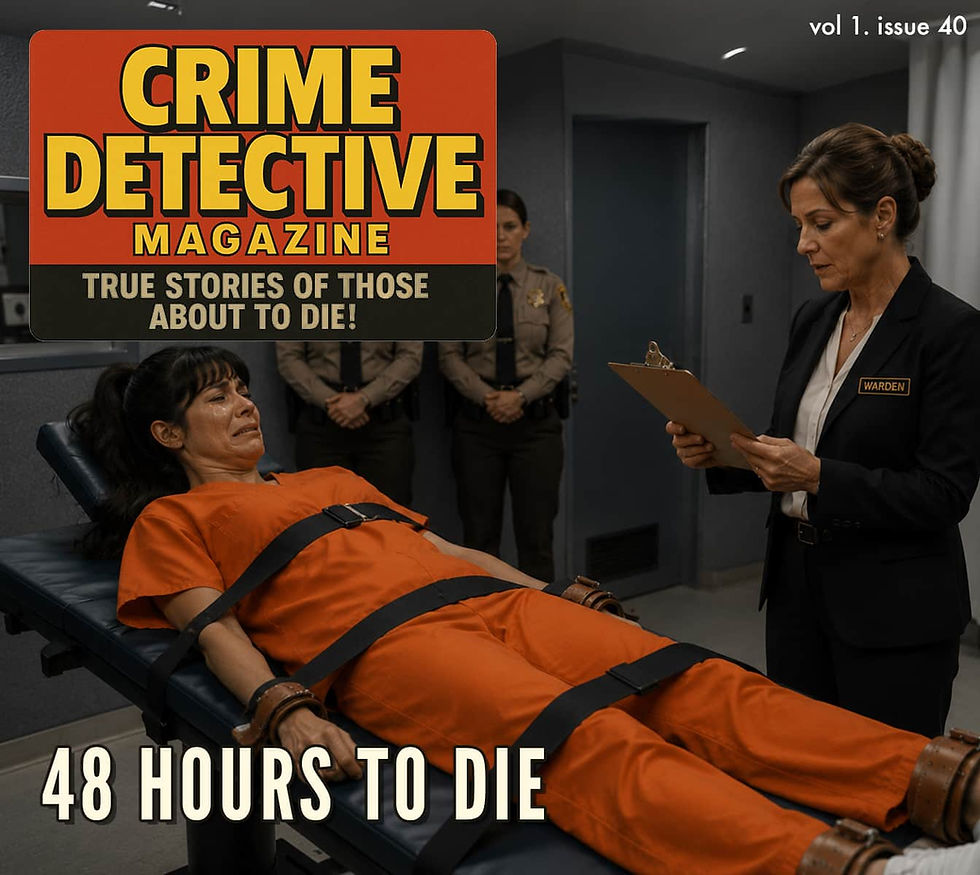
JANET BAKER AND THE PRICE OF BLOOD
- Jun 4, 2025
- 5 min read
Updated: Jun 21, 2025
Chapter One: Blood in the Lot
The summer of ’77 came down on Pensacola like a fever. The sun baked the blacktop ‘til it sizzled, and the heat turned tempers sour. That’s when Janet Baker, twenty-nine, divorced, and fed up with a world that took more than it ever gave, stepped into infamy.
She’d been trailin’ Clarence Bellows for weeks—waited for a day he didn’t have his driver or his briefcase full of excuses. That day came in the Winn-Dixie parking lot, late afternoon. She parked two rows over in a rusted Oldsmobile and watched him waddle toward his Buick like a man too comfortable in his own safety.
The first bullet hit him in the gut. He staggered, eyes wide, and she demanded his wallet. When he hesitated, she shot again—right in the chest. Clarence fell with his neck at a funny angle, eyes frozen in shock. Blood pooled on the hot asphalt.
Officer Billy Tarp, dressed in civvies and carryin’ milk, saw the whole damn thing. He shouted, reached for his badge—and she shot him without thinkin’. Right in the throat. He dropped that milk like it was Sunday’s sermon.
Janet fled the scene with $212 in her handbag, a smoky revolver, and a death sentence already trailin’ behind her.
The trial was a circus.
The courtroom filled up faster than the Baptist church on Easter Sunday. News crews buzzed like flies on roadkill. Janet came in with her hair curled and a smug smile on her face. First day, she blew a kiss to the cameras. Jurors noticed.
Her defense was weak, and her attitude was poison. She interrupted witnesses, called the prosecutor a "bald rat in a suit," and smirked through testimony from Officer Tarp’s widow.
At one point, when her public defender tried to plead temporary insanity, Janet rolled her eyes and muttered, "Insanity? I knew exactly what I was doin'. I meant it."
The courtroom fell dead silent.
Judge Carlisle, a man known for handin’ out heavy sentences with the same ease as Sunday coupons, was visibly irritated. “Miss Baker,” he said, drawlin’ low and slow, “you keep showin’ this court your behind, and I’ll make sure your execution date comes quicker than payday.”
The jury returned in less than three hours.
Guilty. Two counts of murder in the first degree. Death by electric chair.
She smirked even then, but it was weaker now—like a flame flickerin’ in the wind.
. . . . . . . . . . . . . . . . . . . . . . . .
Chapter Two: Death Row
They took her straight to Lowell Correctional Institution, the women's wing. A squat brick building with thin mattresses and steel doors, and the smell of bleach and despair in the air.
Her cell was narrow, just enough space to pace three steps from bars to wall. The toilet gurgled when it wanted, and the light above buzzed all night like some kind of cosmic joke.
The guards didn’t take to her.
They called her "Live Wire" and made little buzzzzzz noises outside her cell at night, laughin’ like boys in a locker room. “You hear that, Jan?” they’d say. “That’s what you’re gonna hear before you fry.”
They talked openly about upcoming executions, discussin’ voltages like coffee orders. “Two seventy-five volts to the head,” one would say. “Enough to make her eyes pop.”
The nightmares started early.
She’d jolt awake, drenched in sweat, thinkin’ the switch had been pulled. Her hands twitched in her sleep. That cocky grin of hers? Long gone.
After years of letters, court filings, and denials, Janet stopped fightin’. One day she asked for a Bible. Said she was tired of pretendin’ she wasn’t scared. That’s when she met Sister Marjorie, a small woman with big faith and a soft drawl who started visitin’ weekly.
“She’s got a heart under all that fury,” the sister said. “She just don’t know what to do with it.”
When her last appeal failed, Janet was transferred to Death Watch. That meant new clothes—white cotton shirt, elastic pants, and Velcro seams so they could cut ‘em off easy. She was moved to the wing nearest the execution chamber at Florida State Prison in Raiford.
There, the lights never went off. The air smelled metallic. You could hear the generator hummin’ behind the walls.
. . . . . . . . . . . . . . . . . . . . . . . .
Chapter Three: The Chair
The night before, she barely slept. She sat up writin’ one last letter to her daughter, full of regret and not enough time. At 4:00 a.m., she met with her lawyer. He was tired. Said the governor wasn’t takin’ calls.
Janet asked, “You think he’s gonna save me?”
He didn’t answer.
At 6:00 a.m., Sister Marjorie arrived. They sat in silence, hands clasped. She recited the Lord’s Prayer while Janet mouthed along, voice quiverin’.
At 6:55 a.m., the guards came.
“Time,” one said.
They led her down the green-tiled corridor, dubbed the Last Mile. It felt longer than it was. The walls didn’t echo. Just the steady click of boots and the soft rustle of her clothing.
The chamber smelled of oil, copper, and old sweat. In the middle sat “Old Sparky,” Florida’s wooden electric chair with thick leather straps and bolts worn by use.
They sat her down.
Her ankles were strapped to the base, tight and snug. Her arms to the rests. A leather chest belt pressed across her sternum. A black hood was placed over her face.
Then came the electrodes—one on the right leg, shaved and slicked with saline gel, and one fastened to her scalp beneath a wet sponge, locked in with a copper crown.
The warden read the warrant.
“Janet Louise Baker, you have been sentenced to death by electric chair for the murder of Clarence Bellows and Officer William Tarp. May God have mercy on your soul.”
7:01 a.m.
The switch was thrown.
Her body arched once. Twice. Smoke curled from beneath the hood. They hit her with a second jolt for good measure.
By 7:06 a.m., she was still.
Postscript: The Price of Blood
Janet Baker wasn’t a hero. She was a woman who let revenge rot her soul ‘til all she saw was red. Some’ll say she was a victim of a broken system, others a monster wearin’ lipstick and smiles.
But Florida law’s clear—you kill a cop, you fry.
The chair don’t care why you pulled the trigger. It don’t care about childhood trauma or tears in the dark. When you choose blood, you pay in kind.
Justice ain’t always pretty. But sometimes it’s necessary.
Some sins need more than forgiveness. They need fire.