Veil of Leather, Veil of Darkness
- Feb 19
- 26 min read
The state of Tennessee hasn’t used ‘Old Sparky’ in years. But for Sarah Jean Robinson, the law reached back into a darker time. Her crime—a jealous, brutal murder at nineteen—was of an old, brutal nature, so the sentence matched. At 7:26 PM tonight, the current stopped, and the youngest woman ever on the state’s death row ceased to be. These are the fragments of her final two days.
Hour 48: The Awakening
It wasn’t the guard’s key that woke her, but the silence that followed its turn. No morning clatter, no distant breakfast cart. Just two sets of footsteps. Sarah knew, her body knowing before her mind. The appeals were gone, burned up like paper in a furnace. The warden’s words were a flat, formal drone: “The court has denied… execution set for 7 PM… transfer to Riverbend.”
Her bravado, that East Tennessee grit that had curled her lip at judges, failed. A cold, liquid dread seeped into her bones. They let her dress in the plain whites, her hands cuffed through a slot in the door. The transport van smelled of old sweat and antiseptic.

Hour 24: The Watch
The cell at Riverbend was a concrete box painted the color of weak tea. Ten feet by twelve.
A concrete slab jutted from the wall with a thin mattress rolled at its foot, and a combination sink-toilet unit squatted in the corner like a porcelain accusation. But the furniture wasn't what Sarah noticed. It was the watching.
A camera lens in the upper corner, high and unreachable, stared at her with its single red eye. The light never blinked, never wavered, never slept. She found herself staring back at it, a perverse staring contest with a machine, until her eyes burned and she had to look away. But even then, she felt it. The weight of that red eye on her skin.
Every fifteen minutes, the observation slot in the heavy steel door slid open with a metallic scrape. A face would appear—sometimes male, sometimes female, always with the same flat, assessing gaze.
Checking for breathing. Checking for consciousness. Checking that she hadn't somehow evaporated into the thin, recirculated air.
Sarah tried ignoring them at first, turning her back to the door. But the scrape would come, and she would feel those eyes on her spine, and she would tense, waiting for the slot to slide shut again. It was like being watched by a clock. Precise. Relentless. Inhuman.
Time became a strange, syrupy thing. Without a window, without a clock, without any marker except the fifteen-minute intervals, the hours bloated and collapsed into themselves. She tried to count the visits, to build a scaffolding of minutes, but she kept losing track around forty or fifty, her mind wandering down dark corridors she didn't want to explore.
Her legal team arrived in the late afternoon. Two of them: a man and a woman she'd seen at the trial, though their names escaped her now, slippery as fish. They brought folders and briefcases and the particular smell of coffee and courthouse dust. Their faces wore the expression she was coming to recognize—professional fatigue, a kind of exhausted compassion that had been worn smooth by too many last visits, too many hopeless cases.
"We've exhausted the federal appeals," the woman said. Her voice was gentle, but the words landed like stones. "The governor declined clemency this morning."
Sarah nodded. She understood the words, understood their meaning on some distant, intellectual level. But they seemed to be happening to someone else, some other girl in some other cell. The Sarah Jean who had scrapped in schoolyards, who had kicked out a window at fourteen just to feel the glass shatter, who had stood trial with her chin raised and her eyes defiant—that Sarah seemed to have packed up and left, abandoning this hollow body.
"There are... logistical matters to discuss," the man said, clearing his throat. "Tomorrow morning, they'll—"
"I know what they'll do." Her voice came out strange, scratchy, like it belonged to an old woman. "I heard it at the trial. Shower. Shave. Diaper. Walk." She counted on her fingers, each word a nail. "Helmet. Strap. Curtain. Chair."
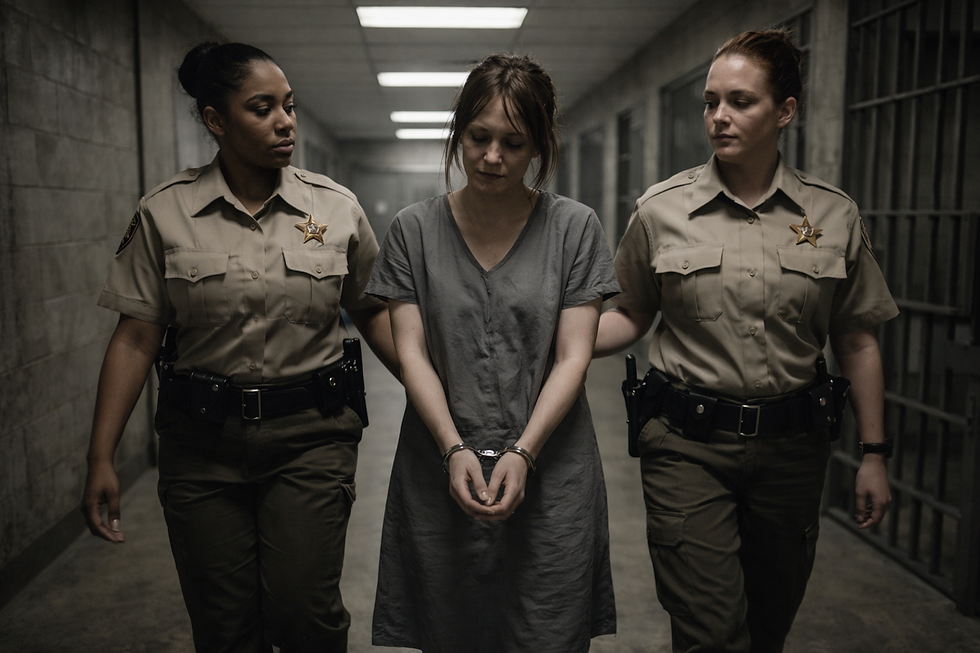
The female attorney's eyes glistened. She reached toward the slot where Sarah's cuffed hands rested, then stopped herself. Touching wasn't allowed. "Is there anyone you want us to call? Your mother?"
Sarah laughed at that—a sharp, broken sound that bounced off the concrete walls. "Mama?
That woman sent me away when I was fifteen. Military school to 'fix' me. Fixed me good, didn't it?" She held up her cuffed hands. "Besides, she probably read the news and figured she'd wait for the obituary. Save on long distance."
"Do you understand what's happening, Sarah?" The man's voice was clinical now, doing his duty, checking the box. "Do you understand the process?"
She met his eyes. "I'm gonna die tomorrow. That's what I understand. The rest is just details."
They left after that, promising to return in the morning if she wanted them to. She didn't answer. The door clanged shut. The red eye watched. Fifteen minutes later, the slot scraped open. A face. Then closed.
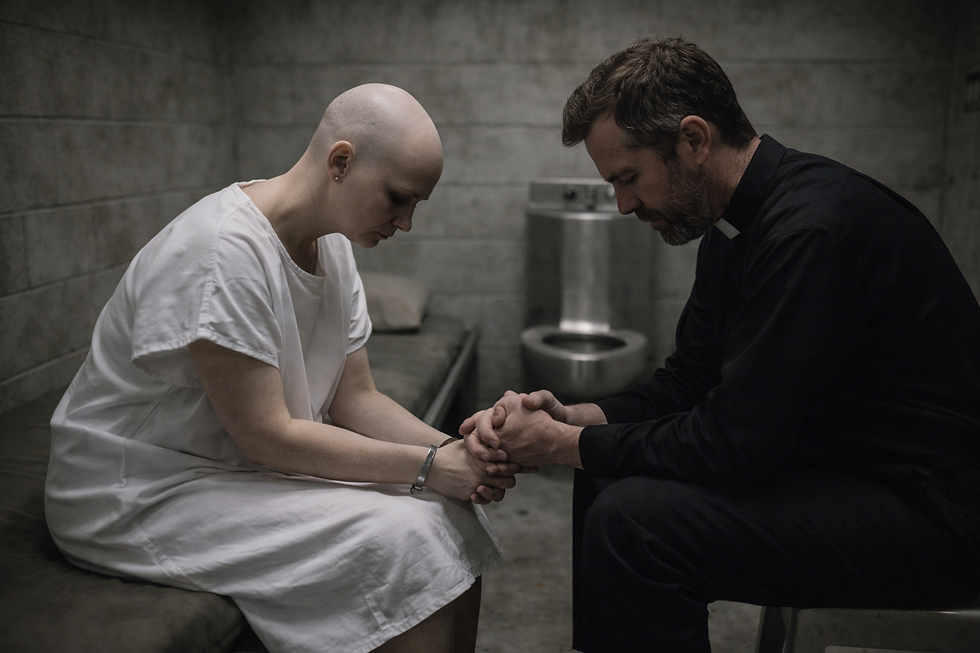
The spiritual advisor came as the light through the nonexistent window began to fade—not that she could see it, but she felt it somehow, a deepening in the quality of the air, a settling of the building's bones. He was old, this man, with thin white hair and the kind of deep-set wrinkles that spoke of decades of smiling and crying with strangers. His eyes were the soft brown of worn velvet, and when he looked at her through the slot, she didn't feel assessed. She felt seen.
"I'm Father Michael," he said. "May I come in?"
She shrugged. "Ain't like I got plans."
They let him in—a privilege of the dying, apparently. He sat on the edge of the concrete slab, his old bones creaking, and folded his hands in his lap. He didn't speak for a long moment, just sat with her in the humming silence of the cell.
"I heard you grew up in East Tennessee," he said finally. "The hills."
"Possum Holler," she said. "Not even a town. Just a road and some trailers and a whole lot of nothing."
"My people are from Johnson County. Over near the North Carolina line." He smiled, and it was like watching a light turn on. "We probably share some cousins somewhere, way back."
Sarah almost smiled back. Almost. "If we do, they're probably in prison too."
He laughed softly, and the sound was warm, human, a small defiance against the concrete and the watching eye. "Maybe so. The hills breed a certain kind of stubborn."
They sat in silence again, but it was different now. Less empty. More like two people sharing a porch swing, watching the sun go down.
After a while, he said, "Would you like to pray with me?"
The word landed strange. Prayer. She remembered her mama on Sunday mornings, hungover and furious, dragging her to the little white church at the crossroads.
Remembered the collection plate passing, the worn dollar bills, the way her mama's lips moved silently through prayers she'd known since childhood. Remembered taking a five-dollar bill from that plate when she was eight, just to see if she could, just to feel the thrill of taking something holy.
"I ain't prayed since I stole from the offering plate," she said. "Probably don't count, coming from me."
"He doesn't keep score that way," Father Michael said. "Just showing up counts."
So she tried. She closed her eyes—a mistake, because the darkness behind her lids was too close to the darkness coming—and she tried to find the words. What came out wasn't the formal prayer the Father offered, his voice a gentle murmur of psalms and comfort. What came out was something else entirely, a mangled, half-remembered thing from childhood:
Our Father who art in heaven, hollowed be thy name... thy kingdom come, thy will be done, on earth as it is in heaven... give us this day our daily bread and forgive us our trespasses as we forgive those who trespass against us...
She stumbled over the words, mixing up the order, forgetting whole phrases and substituting others. It was like trying to recall a song she hadn't heard in twenty years, the melody there but the lyrics blurred. And all the while, the words sat on her tongue like dust, dry and flavorless and somehow mocking.
Lead us not into temptation but deliver us from evil... for thine is the kingdom and the power and the glory forever and ever...
She trailed off. Opened her eyes. Father Michael was watching her with those velvet eyes, and there was no judgment there, only a profound and aching tenderness.
"That was beautiful," he said.
"It was wrong. Got it all messed up."
"He doesn't care about the words being perfect. He cares about the heart saying them." He paused, then added gently, "What were you praying for, Sarah? At the end there?"
She hadn't realized she'd been praying for anything specific. But as she sat with his question, she felt it rise in her—a terrible, consuming weight that she'd been carrying so long she'd forgotten it was there. Sorrow. Not for herself, not really. For the girl she'd killed. For the jealousy that had risen in her like floodwater, dark and fast and merciless. For the boy they'd both loved, who now carried that memory forever. For her mama, who had tried and failed and given up. For the hollowed-out shell of herself, sitting on a concrete slab, waiting to die.
"I'm sorry," she whispered. The words cracked in the middle, splintered like old wood. "I'm just... so sorry."
The tears came then—not the wild, hysterical crying of the morning, but something quieter, deeper, a well finally tapped. Father Michael didn't move to touch her—he seemed to understand that touch wasn't what she needed—but he prayed aloud while she wept, his voice a steady current carrying her through the flood.
When the guard's slot scraped open at the next fifteen-minute mark, Sarah didn't flinch. She was still crying, still sorry, still terrified. But for the first time in twenty-four years, she wasn't alone in it.
Father Michael stayed until they made him leave, well past visiting hours. At the door, he turned back. "I'll be here tomorrow," he said. "As long as they'll let me. As long as you want me."
She nodded, not trusting her voice. The door clanged shut. The red eye watched. Fifteen minutes later, the slot scraped open.
But something had shifted. The weight was still there, crushing and real. But beneath it, barely perceptible, something else had awakened. A small, fragile thing. Not hope—that was too strong a word. But maybe, just maybe, the possibility that when the current came, she wouldn't be entirely alone in the dark.

Hour 12: The Preparation
The last morning came not with light but with sound. The scrape of the observation slot, the clatter of a tray, the shuffle of feet. Sarah had not slept—could not sleep, her body wired with a terrible alertness that had nothing to do with rest. She had lain on the thin mattress, staring at the ceiling, counting the cracks in the concrete, listening to her own heartbeat like a clock counting down to zero.
When the door opened, she knew. This was it.
Three female guards entered. Their faces were not cruel—that would have been easier somehow, easier to hate them, easier to brace against them. Instead, they were simply... empty... professional.
They moved with the efficiency of long practice, their eyes sliding over her like she was already a thing rather than a person.
"Time to get up, Sarah," the tallest one said. Her name tag read "Carson." She didn't meet Sarah's eyes.
Sarah stood on legs that didn't feel like her own. Her body moved, obedient and hollow, while her mind floated somewhere near the ceiling, watching from the corner with the camera's red eye.
The shower was in a separate room, down a short corridor. She walked between two guards, her cuffed hands making small clinking sounds with each step. The third guard followed behind. Through the observation windows in other doors, she caught glimpses of other cells, other lives, other women who would wake up tomorrow and go on breathing. She hated them for a moment, a hot flash of jealousy so fierce it surprised her. Then it faded, leaving only exhaustion.
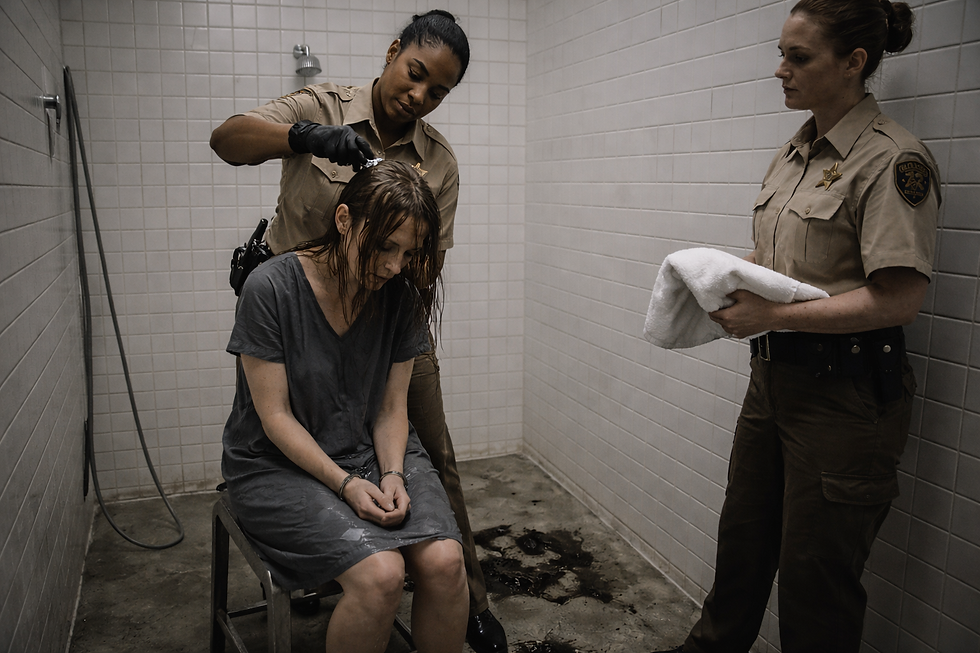
The shower room was tiled in white, clinical as an operating theater. A single metal stool sat in the center, bolted to the floor. A handheld showerhead hung from a flexible hose on the wall. On a small metal cart sat plastic bottles—shampoo, soap, something else she couldn't read—and a stack of white towels.
"Arms up," Carson said.
Sarah raised her hands. The cuffs came off. She rubbed her wrists without thinking, the skin raw and marked. Then, mechanically, she began to undress. The guards watched without watching, their eyes fixed on points just past her—her shoulder, the wall, the floor. She pulled off the white prison shirt, the thin pants, the underthings. Naked now, exposed, she stood shivering in the cold air.
"Sit down."
She sat on the metal stool. It was freezing against her bare skin, and she gasped, a small involuntary sound that none of them acknowledged.
The water came on—warm, at least, blessedly warm. One of the guards, the youngest one with a round face and a name tag reading "Martinez," picked up the showerhead and began to wet her down. The water ran over her shoulders, her back, her chest. Sarah closed her eyes and pretended, for just a moment, that she was a child again, standing in the tin shower stall in the trailer, her mama yelling at her to hurry up before the hot water ran out.
Then Martinez began to wash her. The shampoo smelled like something from a cheap motel, sharp and chemical. Fingers worked through her hair, scrubbing her scalp with the same efficient detachment a veterinarian might use on an animal. Sarah sat still, eyes closed, and let it happen. What else could she do?
The soap came next, a pink liquid that lathered white. Martinez washed her arms, her back, her chest, her legs. No part of her body was private anymore. No part belonged only to her. She was being prepared, like a meal, like a sacrifice, like something to be consumed.
When it was done, the water stopped. They handed her a towel, and she dried herself standing up, her back to them, clutching the rough fabric like it could protect her. It couldn't. Nothing could.
"Time for the shaving," Carson said. Her voice was flat, but something flickered in her eyes for just a moment—something that might have been pity, quickly suppressed.
Sarah's hand went to her hair without permission, fingers threading through the damp strands. Her hair. It wasn't much—thin, mousy brown, the kind of hair that had always frustrated her with its refusal to do anything interesting. But it was hers. It had been hers since she was born, since her mama first held her in the hospital and marveled at the dark fuzz on her tiny head.
"Please," she heard herself say. The word surprised her. She hadn't planned to beg.
"Can I... can I keep it? Just until..."
She trailed off. Until what? Until she died? What difference did it make?
Carson shook her head. "Procedure. I'm sorry."
The words were rote, automatic. But the "I'm sorry" stuck in Sarah's chest like a splinter. She wasn't sure if Carson meant it or if it was just something they were trained to say. Either way, it didn't change anything.
They sat her on the stool again. This time, Martinez stood behind her with the clippers. Sarah heard them click on—that familiar buzzing sound, like a barbershop, like something ordinary and everyday. Then the cold metal touched the back of her neck.
The first pass was the worst. The vibration hummed through her skull, into her teeth, down her spine. A strip of hair fell onto her bare shoulder, then slid to the floor. Brown against white tile. She stared at it, mesmerized, as Martinez continued.
Zzzzzzzzzzzzzt. Another strip. More hair falling.
Sarah watched in the reflection of a metal panel on the wall—distorted, wavering, but clear enough. She watched herself disappear. The girl in the reflection was becoming someone else, something else. Her head looked smaller without hair, her eyes too large, her cheekbones too sharp. She looked like a plucked bird, like a newborn, like a cancer patient, like—
Zzzzzzzzzzzzzt.
Tears came then, silent and hot. They ran down her cheeks and dripped onto her bare chest, and she didn't wipe them away because her hands were in her lap and she couldn't seem to make them move. Martinez kept shaving, her expression unchanged, though her hand trembled slightly against Sarah's scalp.
When the head was done, Carson knelt in front of her. She held a basin of warm water and a razor—not electric now, but a straight razor, the kind Sarah had seen in old movies, the kind that could cut more than hair.
"Right leg," Carson said.
Sarah looked down at her legs. Both were pale, thin, unremarkable. She'd never thought about her legs before, never considered that one of them mattered more than the other. But they'd told her yesterday—the electrode went on the right leg. Something about the heart, the current, the most efficient path to death.
Carson lifted her right foot, placed it in the basin. The water was warm, almost soothing. She lathered Sarah's calf with shaving cream—the kind her daddy used to use, that sharp, masculine scent that always reminded her of him, of the smell he left on the bathroom counter, of the way he'd lift her up to see herself in the mirror when she was small.
Then the razor. Long, smooth strokes. The hair came away in dark ribbons, floating on the water. Sarah watched them swirl and settle, her tears still falling, her body still and obedient.
"We have to do the other one too," Carson said quietly, not looking up. "For the... for appearance. But the electrode only goes on the right."
Sarah nodded. She didn't ask why appearance mattered. What did it matter what a dead woman looked like?
The left leg was faster. Less careful. When it was done, Carson dried her feet with a towel and set them back on the floor. Sarah looked down at herself—bald head, naked body, legs smooth as a baby's—and didn't recognize the person looking back.
The diaper came next.
It was not offered as a choice. There was no "would you like to" or "we can help you with."
It was simply produced from the metal cart, a thick white bundle that crinkled in the guard's hands.
"This is for..." Martinez started, then stopped. Swallowed. "This is standard procedure. For the... for later. The body sometimes..."
She didn't finish. She didn't have to. Sarah understood. The body sometimes let go. In the final moments, in the violence of the current, control was the first thing to go. They didn't want a mess. They wanted a clean death, a tidy death, a death that could be mopped up and forgotten.
"Can I..." Sarah's voice cracked. She tried again. "Can I do it myself?"
The guards exchanged glances. Carson nodded.
Sarah took the diaper. It felt absurd in her hands, soft and crinkly and utterly humiliating. She had worn diapers as a baby, had changed her little cousin's diapers once at a family reunion, had laughed at how silly they looked. Now she stood in a cold room, naked and bald, holding the final indignity of her twenty-four years of life.
She bent to put it on. Her hands shook so badly she couldn't fasten the tabs. Three times she tried, and three times her trembling fingers failed. Finally, with a sound that was half sob and half something else—rage, maybe, or despair—she sank to her knees on the tile floor.
"I can't," she whispered. "I can't, I can't, I can't—"
The tears came in earnest now, not the silent trickle of before but great heaving sobs that shook her entire body. She knelt there, naked and bald and broken, wearing nothing but a half-fastened diaper, and she wept like the child she had once been. She wept for the girl she killed. She wept for the girl she used to be. She wept for her mama, who had given up on her. She wept for the boy who had started all this, who probably didn't even remember her name. She wept for herself, for the current that waited, for the darkness that would swallow her.
The guards stood frozen. This was not in the training, not in the procedure manual. What do you do when the condemned breaks? What do you say?
After a long moment, Martinez moved. She knelt beside Sarah—actually knelt, on that cold tile floor in her uniform and her sturdy shoes—and she put a hand on Sarah's back. Just rested it there, warm and solid, between her shoulder blades.
"I know," she said quietly. "I know."
She didn't know. She couldn't know. But the warmth of her hand was real, and Sarah leaned into it like a plant leaning toward light.
Carson knelt too, on the other side. Together, wordlessly, they helped her stand. They steadied her while she fastened the diaper tabs. They helped her into the special garment they'd brought—a loose white dress, shapeless and soft, like something a patient would wear. They sat her down and Martinez brushed the loose hairs from her shoulders, tiny dark scraps that clung to her skin.
"Almost done," Carson said. "Then you can rest. You can have anything you want to eat. Anything at all."
Sarah almost laughed at that. Food. As if she could eat. As if her stomach was anything but a knot of terror and sorrow.
But she nodded, because nodding was easier than speaking. She let them lead her back to the death watch cell. She let them settle her on the concrete slab. She heard the door close, the lock turn, the familiar scrape of the observation slot fifteen minutes later.
The red eye watched. The slot opened and closed. Time passed, or didn't.
She sat in her white dress, bald and diapered and waiting, and tried to remember what it felt like to be Sarah Jean Robinson—the girl who scrapped in schoolyards, who kicked out windows, who stood trial with her chin raised and her eyes defiant. That girl was gone now. In her place sat someone else. Someone hollow. Someone prepared.
Someone ready to die.
Hour 0: The Performance
The door opened at 7:03 PM.
Sarah had been watching it for hours, her eyes fixed on the gray metal, her body so still she might have been carved from the same concrete as the walls. She'd stopped counting the observation slot scrapes somewhere around noon, stopped noticing the red eye somewhere after that. Time had become a thick, syrupy thing, each minute lasting an hour, each hour lasting forever.
But when the lock turned—that heavy, final click—time snapped back into focus with brutal clarity.
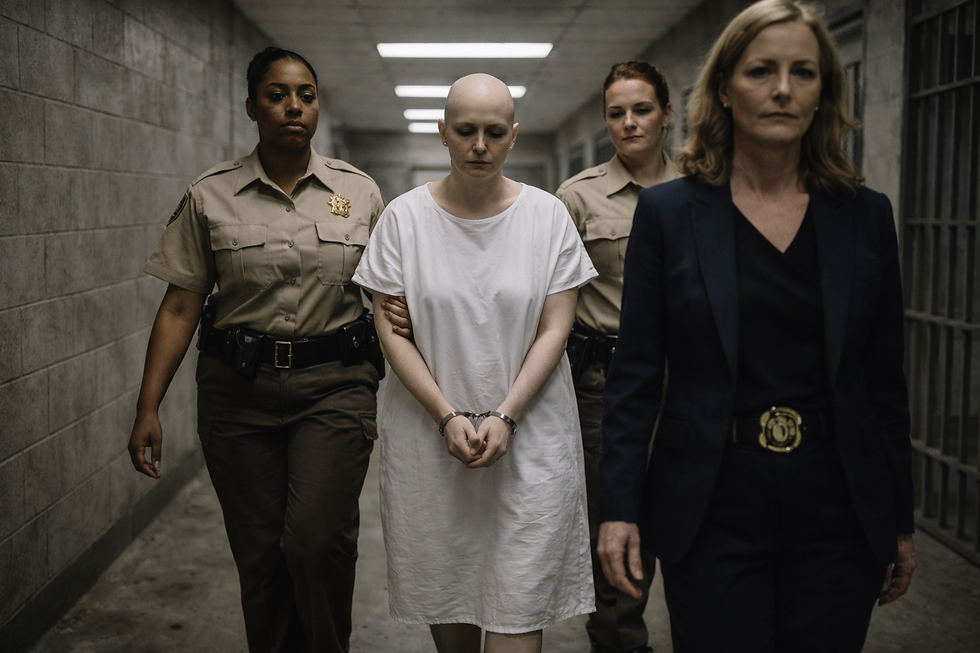
Two guards stood in the doorway. Not the women from this morning—these were men, large men with close-cropped hair and faces that revealed nothing. Behind them, Carson stood with her arms folded, her eyes meeting Sarah's for just a moment. Something passed between them. Not friendship, not even kindness, exactly. Just... acknowledgment. I was here. I saw you. You were real.
"Time to go, Sarah," one of the guards said.
She stood. Her legs nearly buckled—she hadn't eaten all day, couldn't keep anything down—but she found her balance. The white dress hung loose on her body, which seemed to have shrunk somehow, folded in on itself. She was aware of the diaper beneath it, soft and crinkly and humiliating. She was aware of her bare head, the air cold against skin that had always been covered. She was aware of her right leg, smooth as silk, waiting for the kiss of metal.
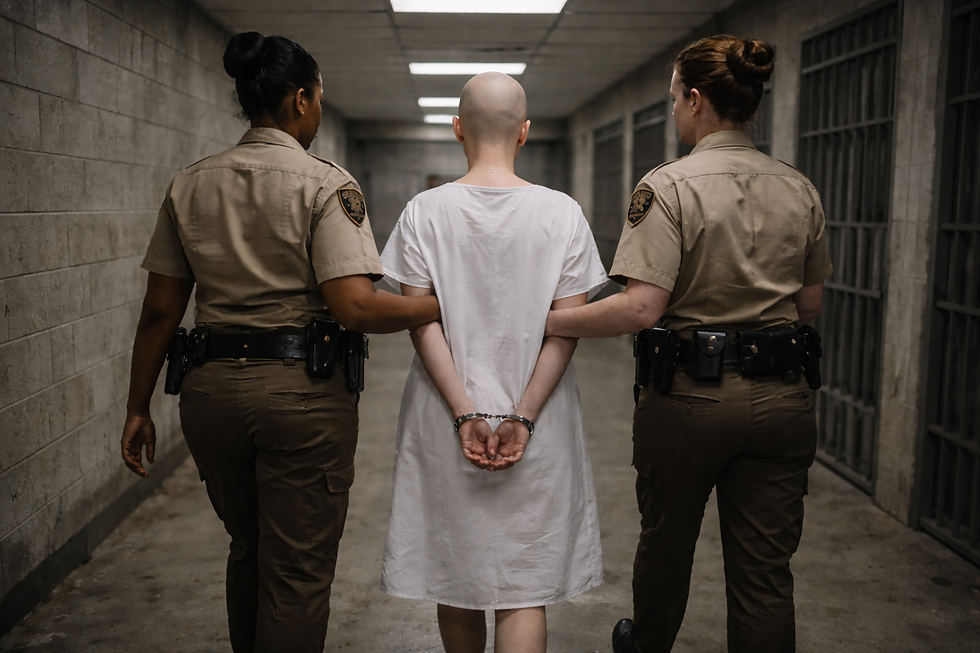
They cuffed her hands behind her back. The metal was cold, tighter than before. Then they walked.
The corridor was longer than she remembered. Or maybe it was the same length, but each step stretched into forever. Fluorescent lights buzzed overhead, casting everything in that sick greenish pallor of institutions. Through observation windows, she caught glimpses of empty cells, empty hallways, empty rooms. The building was holding its breath.
One of the guards—the one on her left—cleared his throat. "You want a priest? He's waiting down there. Can say a few words before..."
Before. Such a small word for such a big thing.
Sarah nodded. Words weren't working anymore. Her tongue felt thick, her mouth dry as paper.
They stopped at a small antechamber, just outside a set of heavy double doors. Father Michael stood there, his old hands wrapped around a worn leather Bible, his velvet eyes wet before he even saw her. When he did, when he took in her bald head and her white dress and her hollow face, a small sound escaped him—a sigh, a prayer, a sob trying to be born.
"Child," he said, and opened his arms.
She walked into them. It was the first time anyone had touched her with tenderness in... she couldn't remember. Years. Maybe ever. His arms were thin but strong, and he smelled like old paper and candle wax and something else, something that might have been holiness or might have been just the scent of a man who had spent his life loving strangers.
"I'm scared," she whispered into his shoulder. "Father, I'm so scared."
"I know," he murmured. "I know. But listen to me, Sarah Jean. Listen." He pulled back just enough to look into her eyes. "When the darkness comes, when it's hard and terrible—you go toward the light. You hear me? You don't look back. You don't look down. You go toward the light, and you keep going until you can't feel anything but love."
She didn't understand. Not really. But she nodded, because nodding was all she had.
He made the sign of the cross on her forehead, his thumb warm and slightly rough. Then he stepped back, and the guards moved forward, and the double doors opened.
The execution chamber was smaller than she imagined.
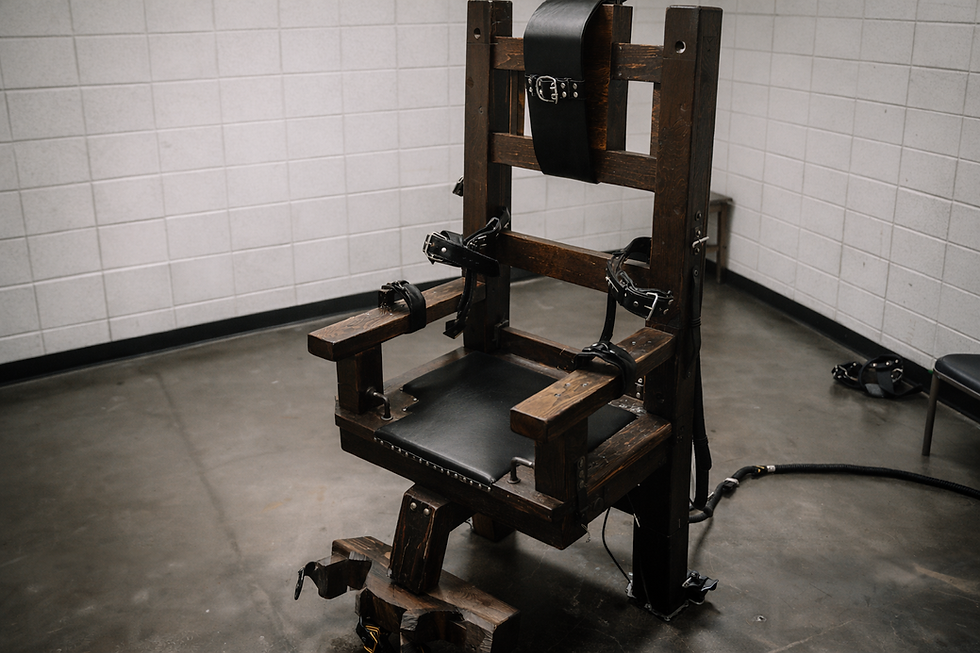
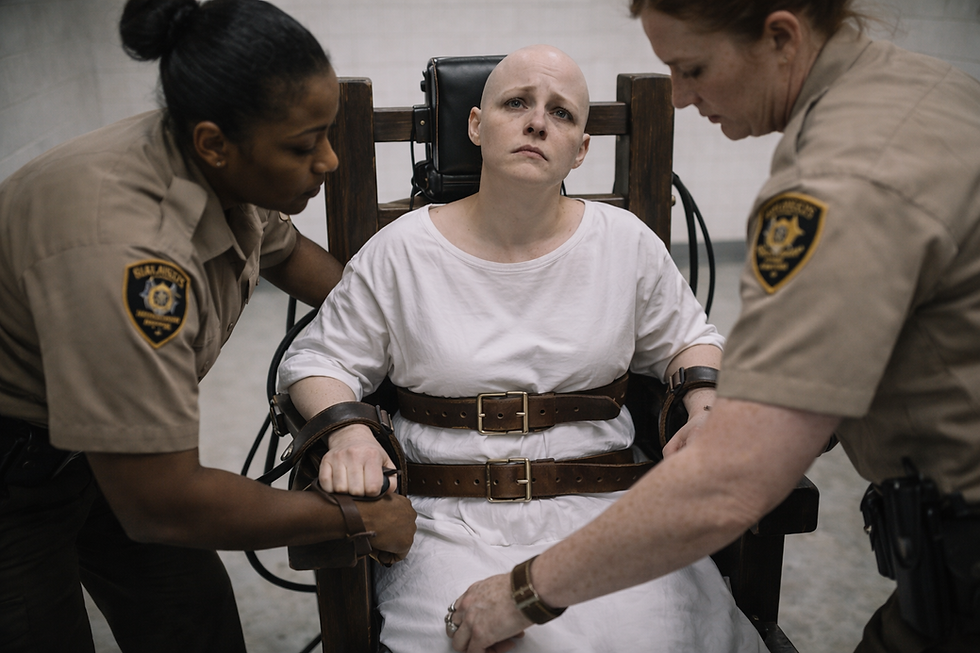
In movies, it was always vast, dramatic, full of shadows and grandeur. This was just a room. Maybe twenty feet square. Fluorescent lights, white walls, a linoleum floor that looked like it had been mopped a thousand times. And there, in the center, sat the chair.
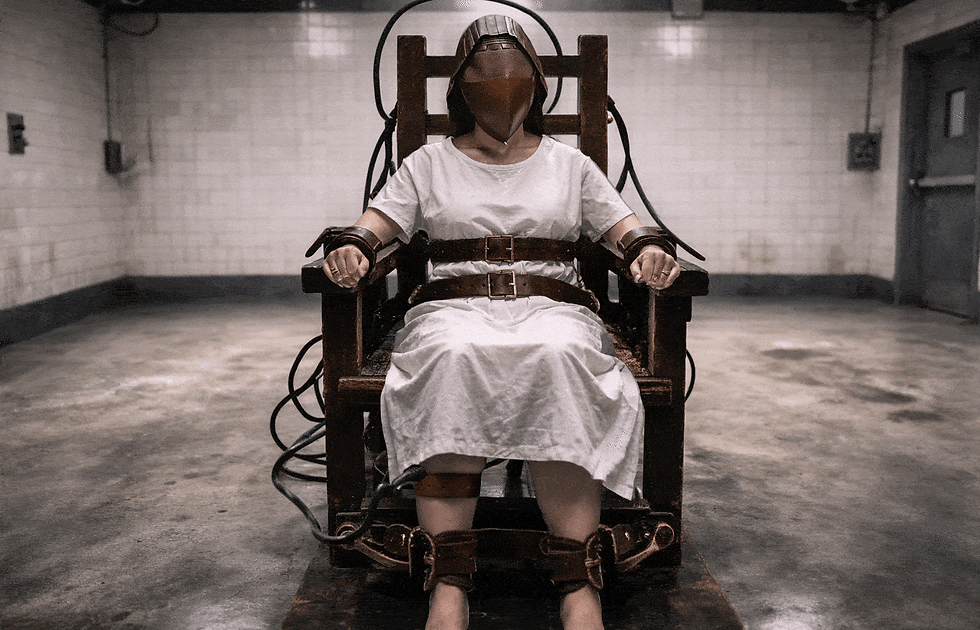
It was wood—dark wood, old wood, polished to a dull gleam by years of use. It looked like something from another century, which it was. Thick arms, a high back, straps hanging from every surface like the limbs of some terrible metal octopus. Wires coiled from the back like snakes, leading to a control box against the wall where a man in a suit stood waiting, his hand on a large black dial.
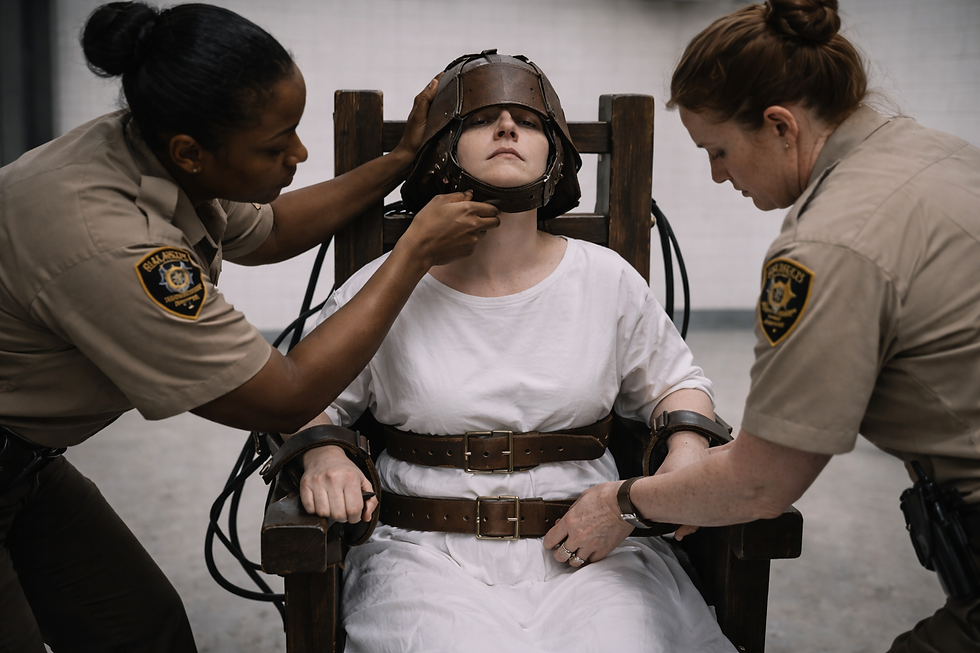
Above the chair, attached to a pulley system, hung the helmet. Sarah could see the sponge inside, damp and glistening. Could see the leather straps that would hold it in place. Could see, bolted to the bottom of the chair, the leg stocks with their gleaming electrodes.
"Oh," she said. It was all she could manage.
They walked her to the chair. Her legs moved, but she didn't feel them. Her heart pounded, but she didn't feel that either. She was floating somewhere above her body, watching from the ceiling, watching from the corner with the camera's red eye.
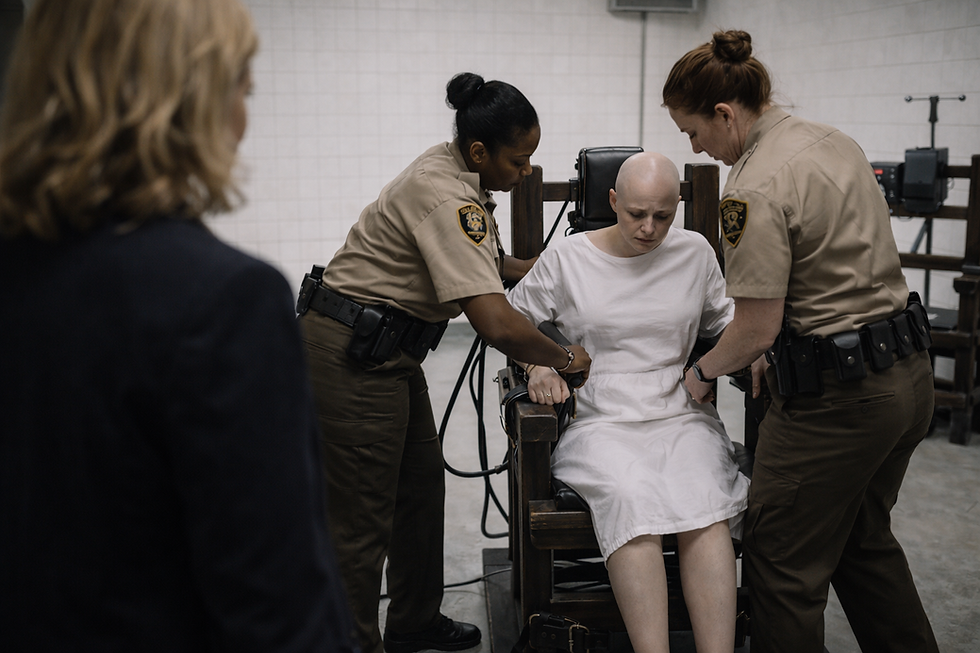
They turned her around. She felt the wood against the back of her knees—cold, so cold—and then she was sitting. The cuffs came off her wrists, and before she could rub the ache away, her arms were being strapped to the chair. Leather across her chest, pulled tight. Leather across her waist, tighter still. Leather around each wrist, around each ankle, around her thighs. With each strap, she felt herself becoming less a person and more an object, a thing to be processed.
The guard on her right—the one who hadn't spoken—leaned close. His breath was warm against her ear. "Breathe," he whispered. "Just keep breathing. It'll be over soon."
She didn't know if he was allowed to say that. She didn't care. She breathed.
The helmet came next.
It descended from the ceiling on its pulley, lowered by a technician she couldn't see. As it approached, she caught her reflection in its polished leather surface—a distorted, wavering version of herself, bald and wide-eyed, a stranger's face. Then it touched her head.
Cold. Wet. Heavy.
The sponge inside was saturated with saline, the brine running down her neck, her back, soaking into the white dress. The helmet settled onto her skull like a crown of thorns, and she felt the electrodes press against her shaved scalp. A technician leaned in, adjusting straps, checking connections. His fingers were impersonal, clinical, moving across her head like she was a mannequin.
"Tight?" he asked.
She couldn't speak. She shook her head slightly, which made the helmet shift, which made him frown and tighten something else.
Then her legs. The stocks at the front of the chair opened, and her calves were guided inside—the left one first, then the right, the bare one. She felt cold metal against her skin, felt the electrodes press into the flesh just above her ankle. More saline, more wetness, more preparation. A guard crouched and smeared conductive gel onto the contact points, his face inches from her skin, his expression utterly blank.
When he was done, he looked up at her. For just a moment, his mask slipped, and she saw something human in his eyes—horror, maybe, or pity, or just exhaustion from too many nights like this. Then it was gone, and he stood, and he stepped away.
She was ready. She was prepared. She was a thing waiting for the switch.
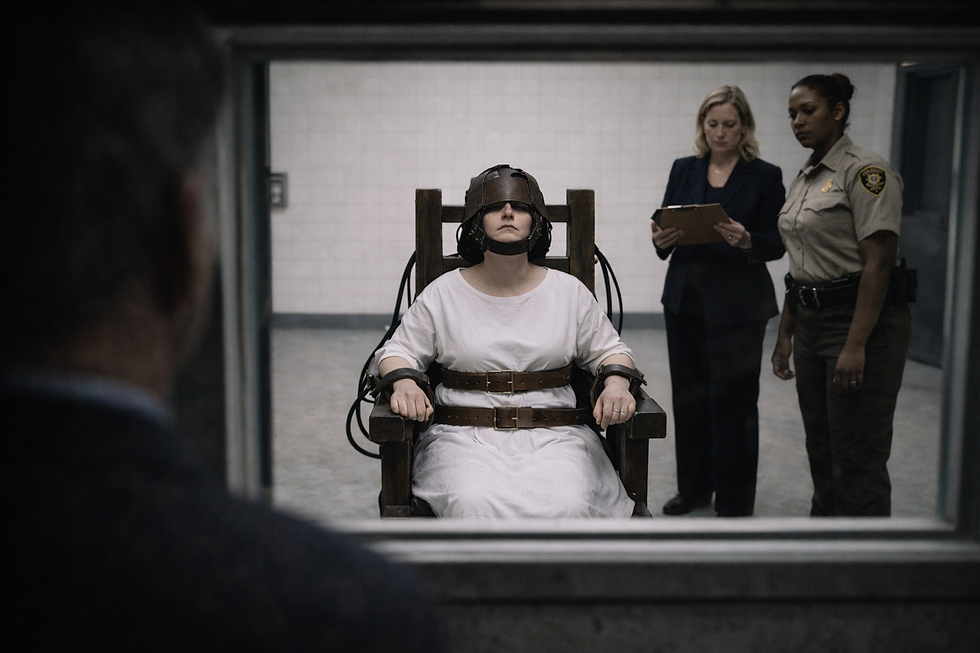
At 7:15 PM, a curtain whisked open.
The sound was sharp, sudden—a gasp, exactly like a gasp. And beyond the thick glass window that the curtain had hidden, Sarah saw them. All of them.
The warden stood in the center, a thin man in a dark suit, holding a clipboard. To his left, a row of officials—the governor's representative, the attorney general's designee, various suits with various titles she'd never remember. To his right, the witnesses. A few reporters, one of them young and pale, his knuckles white where he gripped the ledge in front of him. A chaplain, his lips moving in silent prayer. And behind them, separate, set apart—
The victim's family.
Sarah recognized them from the trial. The father, a hard-faced man with a jaw like granite and eyes that had never once looked at her with anything but hate. The mother, smaller, softer, her face buried in his shoulder even now, unable to watch. Behind them, a younger woman—the victim's sister—who stared at Sarah with an expression she couldn't read. Not hate. Not forgiveness. Just... emptiness. The emptiness of someone who had been hollowed out by grief.
For a long moment, no one moved. The chamber was silent except for the hum of the lights and the distant thrum of the building's machinery. Sarah stared at them, and they stared at her, and between them stretched the uncrossable distance of what had been done.
The warden cleared his throat. "Sarah Jean Robinson," he said, his voice amplified by some hidden speaker. "You have been sentenced to death by the state of Tennessee for the crime of first-degree murder. The sentence is to be carried out at this time. Do you have any last words?"
Last words. Such a strange concept. As if words could matter now. As if anything could.
Sarah opened her mouth. For a terrible moment, nothing came out—her throat was closed, her tongue paralyzed, her mind a blank white scream. Then, from somewhere deep inside, a sound emerged. A word.
"Mama."
It was a child's voice. A little girl's voice. The voice of the Sarah Jean who had once believed in things, who had once thought the world was big and bright and full of possibility.
"I'm so scared." The words tumbled out now, broken and wet. "I'm so sorry. To everyone. To her family. To—" She couldn't say the name. The name of the girl she'd killed. It stuck in her throat like a bone. "I wasn't right. I wasn't ever right. I just... I'm so sorry. I'm so sorry. I'm—"
She broke. The tears came, and the words stopped, and all she could do was sit there, strapped to a chair, wearing a diaper and a helmet, and sob like the lost child she had always been.
From behind the glass, a sound. A muffled sob—not from the victim's family, but from the chaplain. His hand went to his mouth, his eyes closing, his shoulders shaking. The young reporter looked away, his face green. Even the warden's mask slipped for just a moment, his jaw tightening, his eyes dropping to his clipboard.
The father of the victim stood rigid. His jaw worked, muscles bunching beneath the stubble. A single tear tracked down his weathered cheek, catching the light before it fell. He didn't wipe it away. He didn't move at all.
The warden nodded to someone Sarah couldn't see.
A technician approached. In his hands, he held a strip of black leather—the veil, the final curtain. He stepped behind her, and she felt his hands on the helmet, felt him attach the leather across the front. The world went dark.
Suddenly, completely, terrifyingly dark.

The leather smelled of old sweat and something chemical, something sharp that caught in her throat. It pressed against her face, warm and suffocating. She could feel her own breath bouncing back at her, hot and damp. Could hear her own heartbeat, loud as thunder in her ears. Could smell—God, she could smell everything. The saline. The leather. The faint tang of her own fear-sweat. The ghost of a thousand other deaths that had worn this same veil.
Go toward the light. Father Michael's words echoed in the darkness. You go toward the light.
What light? There was no light. There was only this—this waiting, this darkness, this terrible aloneness.
She heard a click. A telephone line being tested. A voice, muffled:
"All clear." Another voice: "Confirmed." Then silence.
She waited. One heartbeat. Two. Three.
7:19 PM.
The hum began low, a vibration she felt in her bones before she heard it with her ears. It built quickly, rising in pitch and volume until it filled the world, until there was nothing but that sound, that terrible living sound like a hive of monstrous wasps descending.
7:20 PM.
Then the current hit.
Later, they would tell her it was painless—that's what they always said, what the reports always claimed. Instant unconsciousness. No suffering. But Sarah Jean Robinson, in that first fraction of a second, knew different.
It was not pain. Pain was a stubbed toe, a broken bone, a knife cut. This was something else entirely. This was existence itself being ripped apart at the seams. This was every nerve in her body screaming at once, a choir of agony so vast and total that it erased everything else. This was light behind her eyes, white and blinding and terrible—not the light Father Michael had promised, but the light of her own body burning from the inside.
Her back arched against the straps. She had no control over it—her body was no longer hers, was merely a thing being acted upon, a puppet with the strings pulled by God knew what. Her fists clenched so hard she felt her nails break against her palms. Her jaw locked, her teeth grinding, a sound escaping her throat that was not a scream—could not be a scream, because the current had locked her lungs, had frozen her diaphragm, had turned her voice box to stone.
It was a groan. Deep and primal and utterly inhuman. The sound of a body becoming something else.
And the smell. God, the smell. It reached her even through the leather, even through the chaos. Acrid. Organic. The smell of cooking meat, of burning hair, of something that should never, ever smell that way. It took her a moment to realize—it was her. It was her.
Twenty seconds.
They stretched into eternity. Each second contained a lifetime of agony, a universe of burning. She was not Sarah Jean anymore. She was not anyone. She was just a nervous system, just a collection of firing synapses, just a thing being unmade.
Then, abruptly, the hum stopped.
Her body slumped.
The tension released so suddenly that she would have fallen forward if the straps hadn't held her. Her head dropped, the heavy helmet pulling it down, her chin hitting her chest.
She was aware, dimly, of steam rising—she could feel it against her cheeks, warm and damp and smelling of her. She was aware of the doctor moving forward, his footsteps careful on the linoleum, his stethoscope glinting under the lights.
She was aware that she was still alive.
How? How was that possible? She had been burned, destroyed, unmade—and yet here she was, still thinking, still feeling, still existing in this dark leather prison. Her heart pounded. Her lungs burned. Every nerve in her body screamed in aftershock.
She heard the doctor's voice, muffled: "She's still—"
Then the hum returned.
This time, she was ready for it—or as ready as anyone could be. This time, she knew what was coming. And somehow, that made it worse. The anticipation. The waiting. The knowing.
The current hit again, and again her body arched, and again the groan escaped her, and again the smell filled her world. But this time, something else happened. This time, in the white-hot center of the agony, she felt something give. Something deep inside her, something that had been holding on, holding together, finally let go.
Go toward the light.
And suddenly, impossibly, she saw it. Not the white light of the current, but something else—something warm and golden, somewhere beyond the pain, beyond the darkness, beyond the leather veil. It was small at first, a pinprick in the distance. But as the current continued, as her body burned and her nerves screamed, that light grew. It expanded. It reached for her.
She reached back.
Twenty seconds. Stop.
Her body slumped again. But this time, she wasn't there to feel it. She was already moving toward the light, already leaving behind the thing in the chair, the burning meat, the empty shell. The light was warm, so warm, and it held no pain, no fear, no sorrow.
A final jolt. Twenty more seconds.
But Sarah Jean Robinson was already gone.
At 7:26 PM, the doctor straightened. He removed his stethoscope, placed it carefully in his pocket, and nodded to the warden. "Time of death, 7:26 PM."
The warden made a note on his clipboard. The officials shuffled, exchanged glances, began the slow process of becoming official again. Behind the glass, the witnesses processed what they had seen.
The victim's father stood rigid, that single tear still wet on his cheek. His wife's face remained buried in his shoulder, her body shaking with silent sobs. The sister—the young woman with the empty eyes—had not looked away. She stared at the body in the chair, at the steam still rising faintly from the helmet, at the limp hands and the slumped shoulders. Her expression did not change. But something in her eyes shifted—a door closing, or perhaps opening. It was impossible to say.
The young reporter stumbled from the room, one hand over his mouth, the other reaching for the wall to steady himself. In the corridor, he would vomit into a trash can, and he would never write about an execution again.
The older officer—a man who had witnessed a dozen of these—simply stared at the floor. His jaw worked, back and forth, back and forth. He did not speak. He did not move. He just stood there, seeing something that none of the reports would ever capture.
The chaplain wept openly, his shoulders shaking, his hands clutching his Bible. He was still praying, his lips moving even through the tears, asking God to receive this child, this lost and broken child, into whatever mercy might exist.
And Carson—the guard who had washed Sarah, who had shaved her, who had knelt beside her on a cold tile floor—stood at the back of the room, her arms folded tight across her chest. Her face was stone. But her hands, hidden beneath her arms, were shaking.
They would unstrap the body. They would remove the helmet, the veil, the leg stocks. They would wash her again, dress her in something decent, prepare her for whatever family claimed her or didn't. They would file reports and sign forms and close the file on Sarah Jean Robinson, case number 87-394, youngest woman ever executed by the state of Tennessee.
But in that room, in that moment, there was only silence. Heavy and absolute. The silence after the storm. The silence after the current.
The silence after a life.
Sarah Jean Robinson, the rotten egg from Possum Holler, the girl who scrapped in schoolyards and kicked out windows and killed in a fit of jealous rage, was gone. Not with a bang, but with a hum. Not with defiance, but with sorrow. Her last words—I'm so sorry—hung in the air like smoke, like prayer, like something that might, in some other world, some kinder world, have been enough.
The lights hummed. The curtain closed. The room emptied.
And somewhere, in a darkness that no longer held any terror, Sarah Jean Robinson went toward the light.