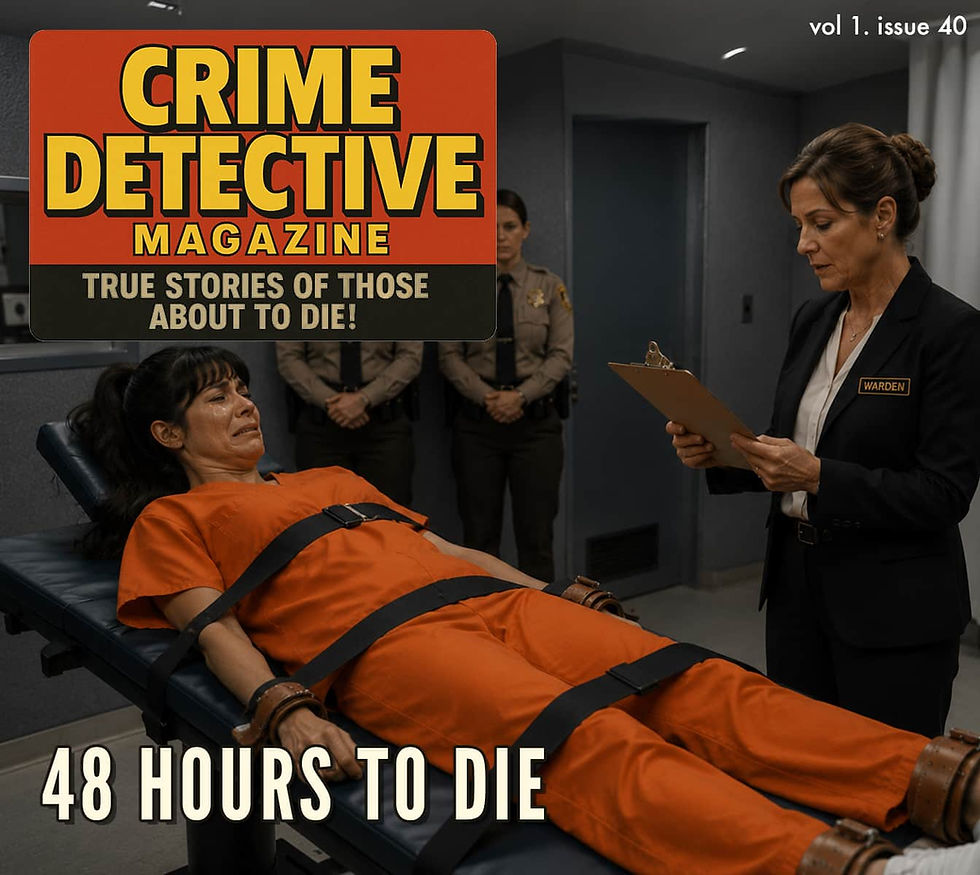
The Long Burn: The Execution of John Louis Evans III
- Jul 17, 2025
- 6 min read
Fictionalized narrative based on true events John Louis Evans III was never meant to live long. Not by his own standards, and certainly not by Alabama’s. Born in Beaumont, Texas, a city that drank like it worked — hard and without pause — Evans cut his teeth in juvenile halls and correctional homes. By 1976, he'd already carved a path from petty theft to armed robbery, graduating from crimes of desperation to acts of calculated violence.
He was lean, quiet, and sharp-eyed — a man who read people like road signs and disregarded both when he was ready to strike. When he walked out of an Indiana prison that summer, no one was expecting him to go straight. Least of all Evans.
He teamed up with Wayne Ritter, another recent parolee, and together they tore through the South like lightning. Alabama. Mississippi. Georgia. Tennessee. Arkansas. They robbed pawn shops, gas stations, diners — whatever looked vulnerable. According to Evans, they hit over thirty spots. Nine kidnappings. Two extortion rings. And it all came to a boiling point inside a small pawn shop in Mobile, Alabama.
Edward Nassar was a father of two. He ran his shop with a warm heart and a wary eye, his young daughters sometimes trailing him behind the glass counters. On January 5, 1977, Evans and Ritter walked in. Minutes later, Edward lay dead on the floor, shot in the back. His daughters, stunned and screaming, watched the killers vanish into the streets with cash and a gun.
The manhunt ended two months later in Little Rock. FBI agents found Evans with the murder weapon and the stolen pistol from Nassar’s shop. It should have been open and shut. Evans even confessed — detailed, unapologetic, cold.
But the prosecutors didn’t want a confession. They wanted a trial. Under Alabama law, a death sentence required a jury conviction. So, they put Evans on the stand, where he turned the courtroom into his own gallows.
“I did it. I’d do it again. Hell, if you don’t kill me, I’ll kill every last one of you jurors.”
The jury took less than fifteen minutes. Death.
The appeals came in waves — legal wranglings about jury instructions, about due process. His mother pleaded for clemency. His lawyers dug in. One court threw out the sentence, another restored it. Evans watched the years tick by from a death row cell at Holman Correctional Facility — a bleak outpost near Atmore, housing the South’s most condemned.
Then, in 1982, Evans did something no one expected. He fired his lawyers and dropped all further appeals.
“I’m tired,” he told the press. “Let’s get on with it.”
April 22, 1983. It was raining in Atmore — thick, southern rain. A line of reporters and state officials filed into the red-brick fortress. Inside, deep in the prison’s bowels, sat "Yellow Mama" — Alabama’s electric chair. Built in 1927 by an inmate and painted the color of traffic warnings, it hadn't been used in nearly two decades.
Evans entered the chamber just before 8:30 p.m. He wore a white prison smock and socks. His head was shaved. He looked calm. The straps bit into his chest, arms, legs.
Warden J.D. White read the death warrant aloud. When it came time for Evans to speak, he looked forward and offered soft words — inaudible to the room.
“I have no hatred,” he said. “No malice.”
The chaplain tried to repeat Evans’ statement aloud. A prison official hushed him.
It was not the way.
The black leather cap was lowered over Evans’ head with slow, deliberate hands, the thick strap pulled tight beneath his chin until his jaw locked in place. Beneath the cap, a sponge soaked in saline water pressed into the freshly shaved crown of his skull — the last touch of human moisture before the storm. Wires dangled from the helmet like blackened veins, snaking down toward the humming junction box bolted to the floor. Another thick cable coiled around his left leg, secured beneath a leather strap over the bare skin just above his ankle.
The room had gone silent — reverent, almost. No one moved, except for the Warden.
J.D. White stood at the far wall, one hand resting on the brass switch. His lips were tight, eyes glassy. The nod came from the booth — the signal had been given.
White pulled the switch.
A monstrous crack filled the chamber as 1,900 volts of electricity tore through Evans’ body. His back snapped against the leather restraints, arching violently. His arms jerked hard against the armrests, fists clenching as if gripping the very air. Sparks erupted from the leg strap — fat orange flares snapping like firecrackers. Then, a burst of flame: the electrode on his leg had blown free, trailing smoke and fire as it clattered to the floor.
A dense puff of greyish smoke spilled out from beneath the face hood, curling upward into the dim ceiling lights. The acrid scent of scorched cotton and human flesh struck the witnesses like a wall. Reporters in the observation room choked, covering their mouths. One turned away to retch.
Evans stopped moving.
For a long moment, there was only the sizzle of smoldering fabric and the distant hum of current winding down.
Two prison doctors entered the chamber, their shoes sticking slightly on the scorched tile floor. One leaned forward, pressed a stethoscope to Evans’ chest, then looked up.
A quiet shake of the head. “He’s not dead.”
A low murmur spread across the observation room. The strap on his leg had been melted loose. A guard — eyes wide, face slick with sweat — stepped forward and reattached it, hands trembling. The execution team reset the controls. The chair, that hulking yellow relic from another century, hummed once more.
The second jolt came.
This time the sparks flew brighter, hotter — white hot and angry. Smoke bled from the seams of the leather hood and from the raw, blistering skin around the leg electrode. A sickening hiss filled the room. The stench now was beyond tolerable — flesh cooked to the point of bubbling. Someone in the witness room began sobbing. Another buried their head in their coat.
And still… Evans breathed.
His chest, bound by thick leather straps, rose in slow, horrible rhythm. A faint thread of saliva rolled down the front of his white smock, glistening against the bloodless fabric. A gasp swept the room.
Russell Canan, Evans’ attorney, took a desperate step forward, pressing himself against the glass.
“Commissioner,” he cried, voice cracking, “this is cruel and unusual punishment. I beg you — grant clemency.”
Fred Smith stood with a stone face, then turned and opened a telephone line to the governor’s office.
“Governor Wallace has been notified,” he said, but gave no comfort.
The line was silent.
It was 8:40 p.m. when the third charge surged.
The switch was thrown one last time, and the chamber filled with the dreadful chorus again — flame, smoke, and the grotesque smell of finality. Evans’ body seized once more, fists still locked to the chair arms like claws of iron. A curl of black smoke trailed lazily toward the ceiling. The leather hood sagged slightly now, as if softened by the heat.
This time, when the doctors entered, they paused longer. They leaned in, listened, waited.
No pulse. No breath.
Only the scent of burnt flesh and charred cotton remained.
At 8:44 p.m., after twenty-four minutes of agony and three full electrical surges, John Louis Evans III was pronounced dead.
The witnesses exhaled — not out of relief, but resignation. The state had succeeded. The machine had done its job.
But the silence that followed wasn’t justice. It was something colder.
And it lingered.
Afterward, the press exploded. First-person accounts detailed a scene out of a nightmare — of fire, of flesh, of a man who wouldn’t die. Some said he fought to stay alive. Others claimed it was simply the body’s final rebellion.
But one truth echoed in every headline: Alabama’s electric chair had failed.
Still, the state called it justice.
Evans was buried quietly. His accomplice, Wayne Ritter, followed him four years later — same chair, same room.
In the years since, Yellow Mama has sat mostly dormant, gathering dust and debate. But Evans remains its most infamous passenger. A man who tested the limits of the law, and in the end, exposed the horror of the machine that answered him back.
He burned. He smoked. He died. But not easily. Not quietly. And not forgotten.